
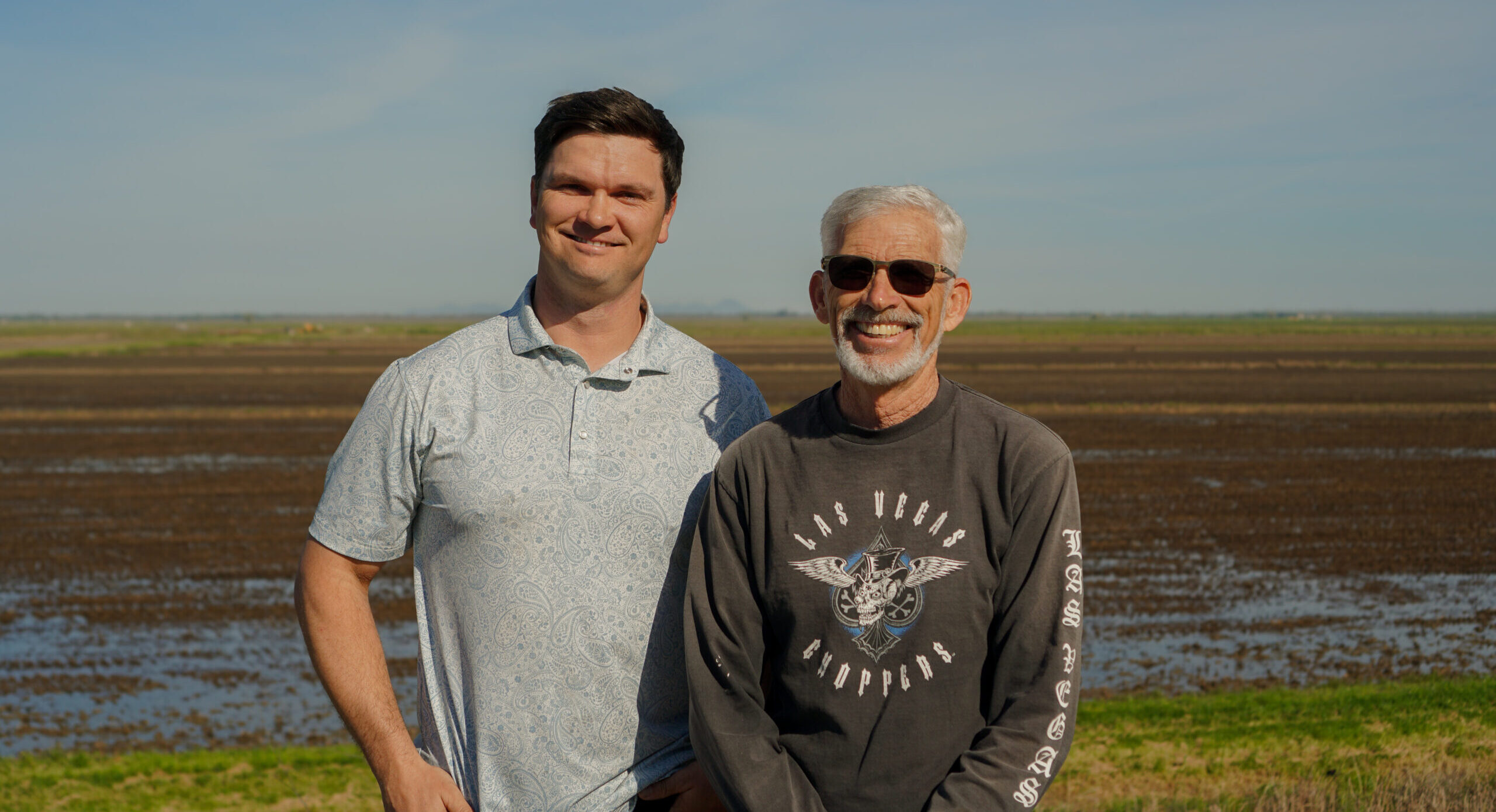
Grower Spotlight: Everett Willey, E.D. Willey & Sons
Forty Crops. Forty Chances to Get it Right.
A rice farmer gets about 40 chances in a lifetime to grow a crop. One season per year, one set of decisions, and one full cycle before you find out if your attention and hard work paid off. Many vocations yield consistent, ongoing results. Farming makes you wait.
Everett Willey thinks about 40 chances a lot. He’s a fourth-generation rice farmer in Nicolaus, California, working the ground his family has held since the late 1920s. He’s also the kind of person who uses a GPS to level his fields within a fraction of an inch, tests driverless equipment on weekends, and studied wildlife ecology before he ever studied agriculture. For Everett, 40 chances are not a limitation. Every single one is a reason to continuously improve.
A Legacy Built on Pivots
The Willey family story begins with the same pivot that a lot of California farming stories do: somebody left everything behind and headed west. Everett’s great-grandfather came out from the Midwest in the early 1920s with his brother. They bought land and planted rice. Then the great-grandfather left to get his wife. When he came back a year later, his brother had gambled away all the land in Sacramento.
“So he had to start over again on his own,” Everett says. “And we’ve been farming rice in California ever since.”
That pivot was nearly a century ago. Four generations later, E.D. Willey & Sons is still in the Sacramento Valley, still growing rice, still figuring out what the next season will ask of them.
Learning the Land Early
Everett grew up in the small town of Nicolaus, just outside Sacramento. On weekends and during the summers, he would head out to the fields with his father, learning to drive trucks at just 12 or 13 years old. It was a hands-on education that no classroom could replicate.
He went to college and initially studied wildlife ecology and conservation, an interest that would later shape much of what he brought back to the farm. Eventually, he switched his major to agricultural science, returned home, and got to work.
What Gets Passed Down
Ask Everett what his father and grandfather gave him, and the answer comes quickly: work ethic. The willingness to do whatever needs to be done, no matter how long it takes. That’s the real legacy.
He’s honest about the realities of farming with family. It doesn’t always go smoothly from one generation to the next. Property has been split up at times, and people have gone their own way. But everyone is still producing.
Now Everett has a daughter, Scout, and the question of legacy has taken on a different shape. He wants her to understand hard work, but he also wants her to understand something his generation has come to value: working smart.
“You can put a lot of effort into something without getting results,” he says. “But if you work smart, you can methodically move forward.”
Precision and the Long Game
That philosophy shows up in how Everett farms. GPS-guided systems have replaced the old laser-leveling methods, enabling him to grade fields to an extremely uniform surface. When water depth is consistent, crops grow more evenly, and grain quality improves. For a region that produces some of the world’s highest-quality medium-grain rice, that consistency is the difference between good and exceptional.
Everett has also explored driverless equipment that can be controlled remotely, allowing one person to do what used to require a whole team. “Automation is the future,” he says. And with only 40 chances in a career, each season putting a year’s worth of decisions to the test, that constraint is what makes him reach for every advantage precision can offer.
Fields Flooded with Life
Every fall after harvest, the Willey fields flood. The main reason is that flooding decomposes the leftover rice straw and replenishes soil nutrients. But for Everett, that’s just one part of the story.
“On my property, one of the main reasons I flood fields is actually for wildlife habitat,” he says. “To me, it makes sense,” he says. “Why not use the land to provide as many benefits as possible?”
This is where his conservation background becomes evident. Upon returning to the farm, he worked with the California Rice Commission and others to implement habitat practices. The flooded fields now serve as seasonal wetlands along the Pacific Flyway, creating habitat for waterfowl, shorebirds, and over 200 species. Programs like Food for Fish use rice fields to feed young salmon.
Everett sees the evidence every day with hawks gathering in the spring fields, 50 or 60 at a time. Not to mention, turtles, otters, and all kinds of birds create a dynamic and shifting habitat through the seasons.
That duplicity has become a philosophy. Grow rice during the season, create habitat in the off-season, and take care of the land so it keeps giving. Farming and conservation are the same work on this property.
Part of Something Bigger
The Willey family joined Farmers’ Rice Cooperative in 1984, and Everett considers it one of the best decisions they ever made. FRC is grower-owned, with a board made up entirely of farmers who understand what it takes to produce a crop. What sets it apart for Everett is the transparency. He can have direct conversations with leadership, and the fieldmen come from farming backgrounds, so they understand what’s happening on the ground.
Some of his favorite memories go back to childhood, attending annual meetings at the Senator Hotel in Sacramento. Everyone dressed up. “It felt important,” he says. It still does. “Growers come together, vote, and participate. There’s something special about being part of that process.”
Making Every Chance Count
Everett eats rice almost every day. Usually steamed white rice, nothing fancy. “That’s the thing about high-quality rice,” he says. “You don’t need to do much to it.”
It’s a fitting line from a farmer who has spent his career making things work better without making them more complicated. Better fields, better technology, better habitat, better rice. Each season, one more chance at perfection.
And somewhere in Nicolaus, a girl named Scout is growing up around all of it. Watching her dad work the fields, hearing the family stories, maybe learning to drive a truck a few years before she’s supposed to. The fifth generation is already in the fields, eyes on the future.
Everett has used maybe half his chances. He plans to make the rest of them count.
Everett Willey farms in Nicolaus, California, as part of E.D. Willey & Sons. His family has been part of Farmers’ Rice Cooperative since 1984.
